
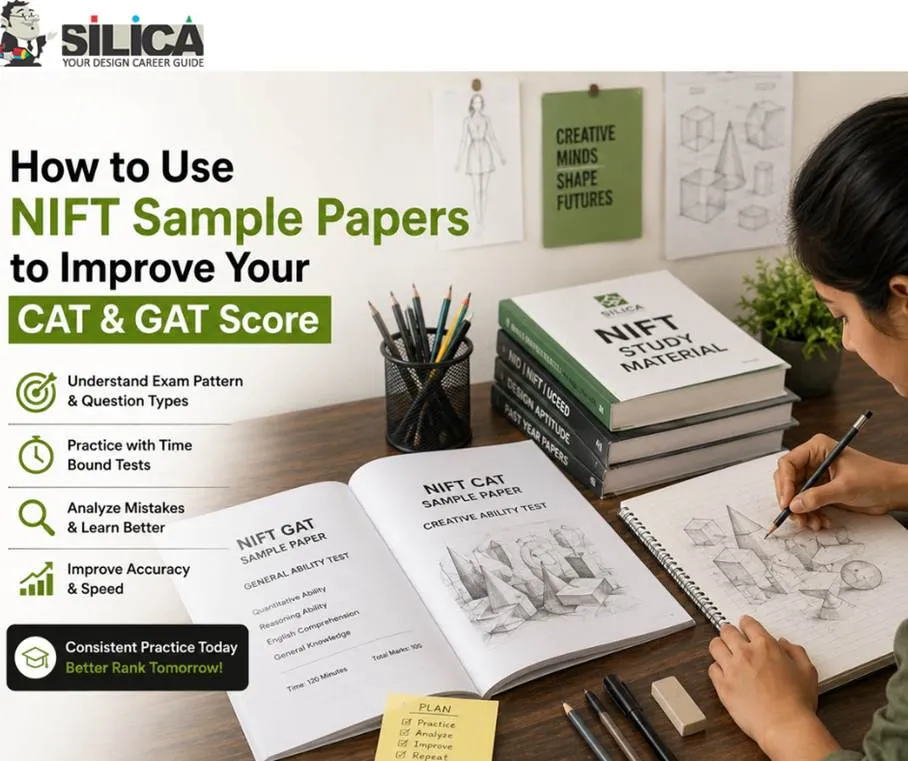
Every year, thousands of design and fashion aspirants sit for the NIFT Entrance Exam, competing for a limited number of seats across India’s NIFT campuses. While understanding the syllabus is a starting point, most toppers agree that consistent, structured practice with sample papers is what actually moves the needle on exam day. Here’s how to use NIFT sample papers strategically instead of just solving them at random.
Why NIFT Sample Papers Matter More Than You Think
The NIFT entrance exam is split into two very different sections — the Creative Ability Test (CAT) and the General Ability Test (GAT) — and each rewards a different kind of preparation. GAT is a timed, objective test of quantitative ability, reasoning, English comprehension, and general knowledge, so it responds well to repetition and pattern recognition. CAT, on the other hand, tests drawing, composition, and conceptual thinking, which means practice is less about memorising answers and more about training your creative instincts under time pressure.
Sample papers that are modelled closely on the current exam pattern let you rehearse both these mindsets — the analytical and the creative — well before the actual exam.
1. Start with GAT to Build Exam Temperament
Most students jump straight into drawing practice because it feels more enjoyable, but starting with GAT sample papers first helps you understand how the exam is structured — the pacing, the negative marking (where applicable), and the balance between sections. Once you’re comfortable navigating GAT under a timer, shift focus to CAT with that same disciplined, time-bound approach.
2. Treat CAT Practice as Skill-Building, Not Memorisation
You cannot memorise your way through a drawing or composition prompt. Instead, use CAT sample papers to build a repeatable process: read the prompt carefully, spend two minutes sketching thumbnails of two or three ideas, pick the strongest one, and then commit your remaining time to execution. Practising this process repeatedly — not just the final drawing — is what makes the difference under real exam pressure.
3. Time Yourself From Day One
It’s tempting to solve sample papers without a timer while you’re still learning concepts, but this builds a false sense of confidence. NIFT is as much a test of speed as it is of accuracy. Attempt every sample paper — even early in your preparation — within the actual time limit, and only review untimed once you’ve submitted your answers.
4. Analyse Mistakes, Not Just Scores
A score alone doesn’t tell you much. After every sample paper, spend time identifying whether a wrong answer came from a concept gap, a careless error, or a time crunch — each needs a different fix. Keeping a simple mistake log by topic (quantitative ability, reasoning, GK, composition, etc.) makes your revision far more targeted in the final weeks before the exam.
5. Use Solutions to Learn Reasoning, Not Just Answers
Good sample papers come with detailed solutions — not just correct options, but the reasoning behind them. For GAT, this helps you spot shortcuts and elimination techniques. For CAT, reviewing sample solutions and expert-annotated drawings helps you understand what evaluators are actually looking for in composition, proportion, and originality.
6. Build a Weekly Practice Rhythm
Rather than cramming sample papers in the last month, spread them across your preparation timeline: one full GAT-style paper and one CAT-style paper per week in the early months, increasing frequency as the exam approaches. This spaced-practice approach tends to build both retention and stamina far better than last-minute intensive solving.
Where to Find Reliable NIFT Sample Papers
The quality of a sample paper matters as much as the quantity you solve. Papers that are outdated or not aligned with the current NIFT pattern can do more harm than good, since they train you for a version of the exam that no longer exists. Institutes with a long coaching track record, such as SILICA Institute’s NIFT Sample Papers resource, update their practice sets each year to reflect the latest CAT and GAT format, and typically include solved papers across B.Des, M.Des, BFTech, and MFM streams — useful if you’re unsure yet which NIFT programme you’re targeting.
Final Thoughts
NIFT sample papers are only as useful as the process built around them. Used with a timer, a review habit, and a weekly rhythm, they can turn generic preparation into a focused, exam-ready routine — which is ultimately what separates a good NIFT score from an average one.